
In today’s world, marketing is more than catchy slogans and billboard ads. Brands must reach people online, track what they do, and adapt in real time. Two terms you’ll often see in this space are Digital Marketing and Performance Marketing. While related, they are not the same. Understanding both helps businesses (and marketers) choose the right approaches—and learners to pick what to specialize in.
What is Digital Marketing?
Digital Marketing is the umbrella term for all marketing efforts that use the internet or electronic devices. It covers everything from content creation and social media to email, SEO (search engine optimization), influencer marketing, display ads, video marketing, and more. The goal is often broad: build brand awareness, engage a community, nurture leads, keep users coming back, and ultimately help drive business outcomes. But many portions of it don’t immediately translate into direct sales.
Key Features of Digital Marketing
- Wide variety of channels: SEO, social media (organic as well as paid), content (blogs, videos), email marketing, display advertising, etc.
- Long-term strategy: Brand building, reputation, customer loyalty, engagement often need time.
- Metrics not always immediate: You measure reach, impressions, engagement rates, time on site, bounce rate, etc.—useful but not always tied to immediate sales.
- Content & storytelling: Good content provides value (education, entertainment), builds trust. Because of that, it supports many stages in customer journey, from awareness to consideration.
Strengths & Weaknesses of Digital Marketing
| Strengths | Weaknesses |
|---|---|
| Builds brand identity and trust | Costs/time before seeing ROI can be high |
| Helps with customer relationship, loyalty | Harder to precisely allocate ROI to specific actions some of the time |
| Allows multiple touch-points (social, email, search, content) | May require sustained investment and consistent content effort |
What is Performance Marketing?
Performance Marketing is a subset of digital marketing that focuses on measurable actions. In performance marketing, you pay for results: a click, a lead, a sale, an install—whatever is the designated goal. If the desired action doesn’t happen, you often don’t pay (or pay far less). It’s inherently result-oriented and data driven.
Key Features of Performance Marketing
- Pay-for-performance model: Advertisers pay when specific actions are completed—Cost per Click (CPC), Cost per Acquisition (CPA), Return on Ad Spend (ROAS), etc.
- Highly measurable: Every campaign is tracked, optimized, adjusted in real time. You know which channels, creatives, or audience segments are working.
- Shorter feedback loop: Because you see results (or lack of them) quickly, performance marketing allows rapid iteration and scale.
- Clear ROI expectations: You can often estimate what a certain spend will likely bring in, because the metrics are directly tied to outcomes.
Strengths & Weaknesses of Performance Marketing
| Strengths | Weaknesses |
|---|---|
| Very efficient use of budget, lower risk if done well | Can focus too much on immediate results, neglecting brand perception or long-term loyalty |
| Clear accountability & ability to optimize quickly | Often competitive (e.g. PPC), can be expensive in saturated markets |
| Works especially well for e-commerce, app installs, immediate lead generation | Sometimes actions don’t capture everything (e.g. offline sales, brand lift, word of mouth) |
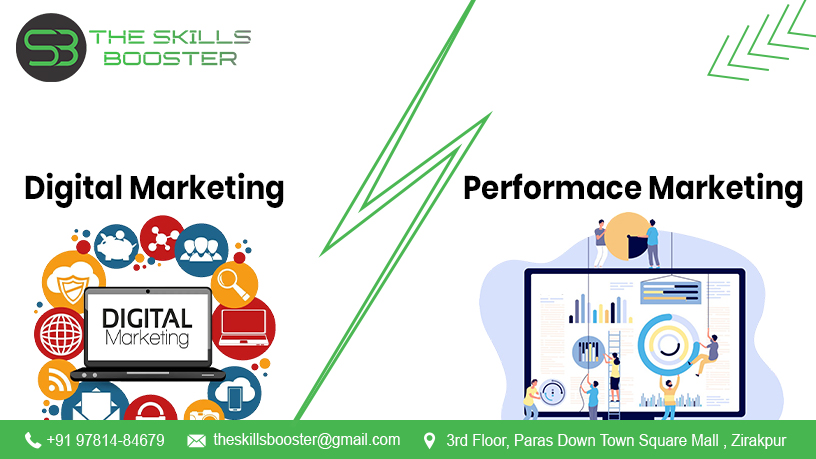
Digital Marketing vs Performance Marketing: Side-by-Side Comparison
Here’s a comparison to show how they differ, overlap, and how they may be used together.
| Aspect | Digital Marketing | Performance Marketing |
|---|---|---|
| Goal/Objectives | Awareness, engagement, brand building, loyalty | Specific actions: leads, sales, downloads, etc. |
| Time Horizon | Medium to long term, gradual growth | Short to medium term; fast feedback & scaling |
| Payment / Cost Model | Cost upfront (content creation, brand campaigns, social presence) with less direct tie to outcomes | Pay per result (CPC, CPA, etc.) |
| Measurement & Metrics | Reach, Impressions, Engagement, Brand Recall, Page Views | Conversion Rate, Cost per Conversion, ROAS, CPA, etc. |
| Channels | Social media organic & paid, SEO, email, content marketing, influencer, etc. | Affiliate marketing, PPC ads, retargeted ads, some social media advertising focused on conversion |
| Risk & Budget | Higher investment without guaranteed immediate return; more risk in creative/brand mismatch | More budget control, but can require high optimization skills to avoid wastage |
| Brand vs Direct Response | More brand-oriented; you build perception, trust | More direct response oriented; each campaign aims for action |
How They Work Together
These two aren’t mutually exclusive. In fact, they often need to go hand in hand if a brand wants both strong awareness and tangible results.
- A company might use digital marketing to build brand authority via content, SEO, social media presence, community building. Over time this builds trust and visibility.
- In parallel, they can run performance marketing campaigns (PPC, affiliate, retargeting) to generate online sales or leads.
- Additionally, insights from performance marketing (which ads, offers, audiences convert best) feed back into the digital marketing strategy (content topics, messaging, audience personas).
This combined approach helps in sustainable growth: you get short-term wins (sales, leads) while also building long-term value (brand awareness, loyalty).
When to Use Each
Here are some example scenarios:
- If you’re launching a new product or startup and need fast user acquisition or revenue, performance marketing is essential.
- If your brand is already known somewhat but you want to scale sustainably, digital marketing helps maintain presence, build trust, reduce customer acquisition cost over time.
- For businesses with smaller budgets, you might start with performance marketing (to see what works), then gradually invest more in digital marketing for long-term return.
Digital Marketing vs Performance Marketing: Key Take-Aways
- Digital marketing is broader; performance marketing is a focused part of it.
- Performance marketing is results-driven; digital marketing often has intangible outcomes (brand perception, authority).
- Both need skills: content creation, understanding audiences, analytics, creative strategy for digital; and for performance: ads, conversion optimization, data analysis, budget management.
- Combining both gives strength—short-term gains and long-term health of brand.
How The Skills Booster Helps You Learn Both
If you’re aiming to build skills in both digital marketing and performance marketing, The Skills Booster (located in Zirakpur, Punjab, India) offers training designed to cover the full spectrum. Here’s how it supports learners:
- Comprehensive Curriculum: Courses include Digital Marketing (covering SEO, Social Media Marketing, Pay-Per-Click, etc.) which overlap with performance marketing elements. So students learn both wide strategies (digital) and outcome-oriented tactics (performance).
- Hands-on, Real-Time Projects: Rather than just theory, you get to work on live projects which likely involve setting up campaigns with measurable goals. This gives experience with performance metrics and testing.
- Experienced Trainers & Certifications: Trainers with real-world experience and credentials (Google, Meta etc.) so you don’t learn outdated theories only. Having certified trainers helps ensure you learn best practices, especially in performance marketing where platform rules change fast.
- Free Demo Class & Placement Assistance: The chance to try a class before committing helps you see whether performance marketing or digital marketing or both resonate with you. Plus, job assistance ensures you’re trained not just academically but in employable skills.
- Balance of Brand & Direct Response Focus: Since their digital marketing course includes elements like PPC and social media ads (which are performance-driven), students are exposed to both brand building and direct-response marketing.
Why Learning Both Matters
- If you only know digital marketing generally but don’t understand performance marketing metrics, you might create campaigns that generate awareness but don’t convert leads or sales well.
- If you only focus on performance marketing, you may get results fast but may struggle with customer loyalty, brand credibility, or scaling beyond immediate conversions.
- Employers today often expect hybrid skills: you should understand brand growth, content & storytelling, and know how to run ads, optimize for conversions, measure ROI.
Conclusion
In the evolving digital landscape, knowing the difference between digital marketing and performance marketing is essential. Reach and perception matter—but so do actual clicks, conversions and revenue. For individuals and businesses alike, mastering both lets you build strong brand presence and achieve measurable results.
If you’re keen to learn these skills in a structured way, The Skills Booster in Zirakpur offers courses and training that cover both digital and performance marketing, with real projects, expert trainers, certifications, and placements.
Contact & Address: The Skills Booster
For those interested, here is The Skills Booster’s contact and location details:
- Name: The Skills Booster
- Address: Paras Downtown Square Mall, Cabin no. 2, 3rd Floor, Zirakpur, Punjab, 140603
- Phone: +91 97814 84679
- Email: info@theskillsbooster.com
- Website: https://theskillsbooster.com/